German vs Dutch: Differences, Similarities, and Which to Learn
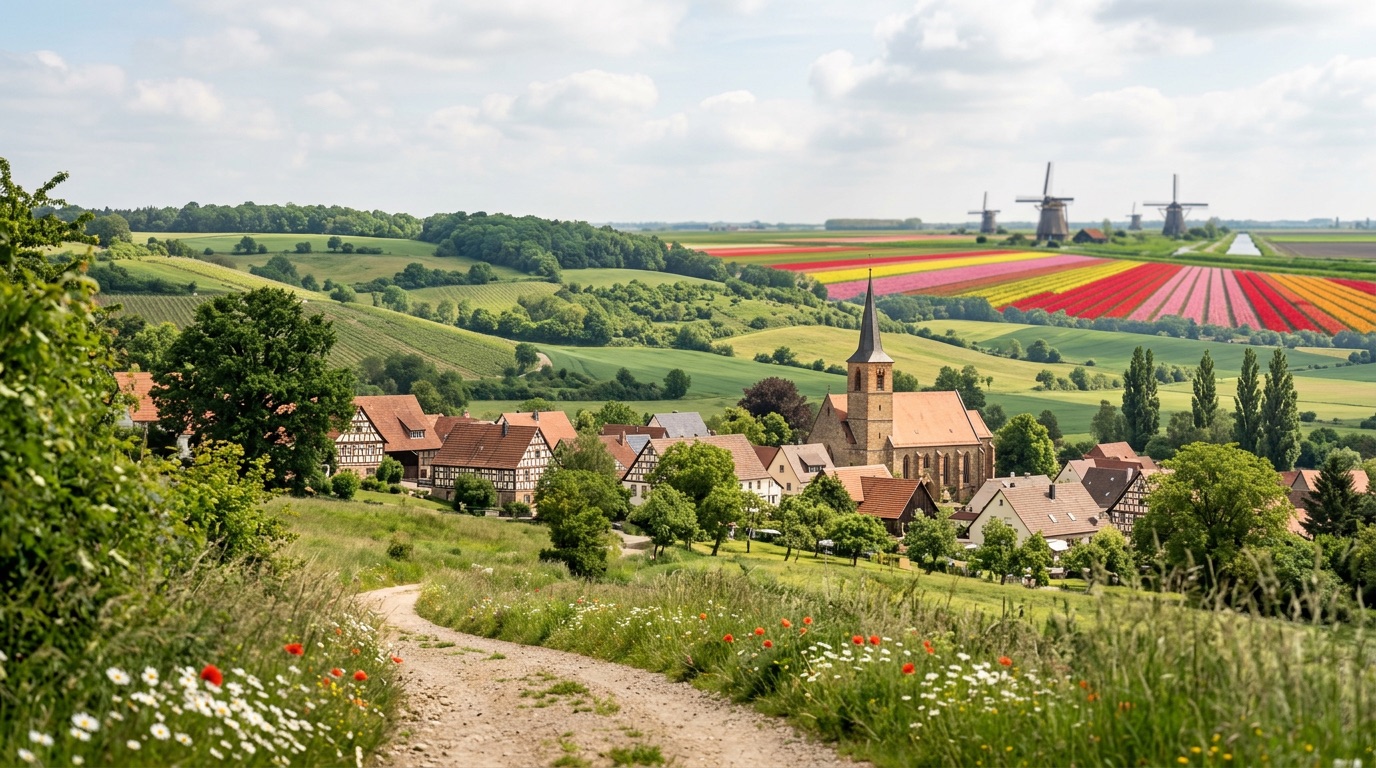
German and Dutch sit side by side on the map and on the family tree. Both are West Germanic languages, descended from the same ancestor as English. They share thousands of words, similar grammatical structures, and enough overlap that a German speaker stumbling into Dutch text can often guess at the meaning. But they diverged significantly, and choosing between them for study is a real decision. Here's the full picture.
How related are German and Dutch?
German and Dutch are sister languages — closer to each other than either is to English, but less similar than, say, Spanish and Portuguese. They share roughly 70–80% lexical similarity (word-form overlap), compared to English-German's ~60%.
Some examples of how close (and how different) the vocabulary is:
| English | German | Dutch |
|---|---|---|
| water | Wasser | water |
| house | Haus | huis |
| book | Buch | boek |
| day | Tag | dag |
| to make | machen | maken |
| I have | ich habe | ik heb |
| beautiful | schön | mooi |
| railway | Eisenbahn | spoorweg |
| hospital | Krankenhaus | ziekenhuis |
The vocabulary is often recognisably related but rarely identical. Pronunciation diverges significantly — especially the Dutch "g" (a guttural sound unlike anything in German) and the vowel system.
Grammar comparison
Grammar is where the difficulty gap between the two languages becomes clearest for English speakers.
Grammatical gender
German: three genders (masculine der, feminine die, neuter das). Gender must be memorised for every noun. Gender affects article forms, adjective endings, and pronoun choice.
Dutch: two genders (common de, neuter het). The distinction between masculine and feminine collapsed into a single "common gender" — so you only need to distinguish between de words and het words. This is a significant simplification.
Case system
German: four cases (Nominativ, Akkusativ, Dativ, Genitiv) with corresponding article changes, adjective endings, and pronoun forms. This is the single most challenging aspect of German for English speakers.
Dutch: cases were abandoned. Modern Dutch has no case system in everyday use. This removes an enormous complexity compared to German.
Verb position
Both languages share the verb-second rule (conjugated verb in second position) and verb-final in subordinate clauses. This similarity means German speakers transferring to Dutch (and vice versa) don't need to relearn sentence structure from scratch.
Comparison table
| Feature | German | Dutch | Easier for English speakers |
|---|---|---|---|
| Grammatical gender | 3 (der/die/das) | 2 (de/het) | Dutch ✓ |
| Case system | 4 cases | None in everyday use | Dutch ✓ |
| Verb position | Verb-second + verb-final | Same | Equal |
| Vocabulary (vs English) | ~60% overlap | ~65% overlap | Dutch slightly ✓ |
| Pronunciation | Consistent, learnable | Guttural sounds harder | German slightly ✓ |
| Native speakers | ~130 million | ~25 million | German (more reach) |
| FSI hours to proficiency | ~750 hours | ~600 hours | Dutch ✓ |
Pronunciation comparison
German pronunciation is phonetically consistent — once you learn the rules, you can read any word correctly. The challenging sounds are the umlauts (ä, ö, ü), the ch sound (two varieties), and the guttural R. But they're learnable within weeks.
Dutch pronunciation has the infamously difficult "g" and "ch" sounds — a harsh, rasping sound produced at the back of the throat that's stronger than German's "ch". Dutch vowels also have significant dialect variation. Many learners find Dutch harder to sound natural in, even if the grammar is simpler.
Dutch also has sounds that "swallow" syllables — words can sound very different from how they're spelled, in ways that German doesn't do.
Which has more utility?
German is spoken by approximately 130 million people across Germany, Austria, Switzerland, Luxembourg, Liechtenstein, and South Tyrol. It's the most spoken native language in the EU and an official language of more European institutions than any other language. German-speaking countries collectively represent the world's 4th largest economy.
Dutch is spoken by approximately 25 million people, primarily in the Netherlands and Belgium (Flanders). It's also spoken in Suriname and parts of the Caribbean (as Papiamento). Dutch-speaking countries include the Netherlands (16th largest economy) and Belgium.
For academic and professional reach, German has substantially broader utility — it's commonly required or preferred for European university programs, international business, research publications, and many government/NGO positions.
Which should you learn?
The answer depends almost entirely on your purpose:
- Learn German if: you want the broader reach, plan to live or work in Germany/Austria/Switzerland, are interested in German-language literature and culture, or need German for academic/professional purposes
- Learn Dutch if: you're focused on the Netherlands or Belgium, want the fastest possible path to West Germanic language competency, or want a stepping stone (Dutch → German is easier than starting German directly)
- Learn both eventually: knowing German makes Dutch significantly easier to learn — the shared structure and vocabulary accelerate acquisition enormously. Many learners do German first, then Dutch becomes a 3–6 month project rather than a 2-year one
Start German with a structured path
DeutschSpeak covers German from A1 to C1 — 5,000+ words, all 4 cases, grammar, listening, and speaking. Free to download today.